PhD research · IIT Delhi · 2020–2026

How functionalised nanoparticles behave in a crowd

Gold nanoparticles are used in biosensing, nanomedicine and catalysis, but the rules for their stability and assembly in realistic, crowded environments are still being worked out. My PhD combined all-atom molecular dynamics, Kirkwood–Buff solvation theory and machine learning, moving step by step from crowded amino acid solutions to a data-driven engine for designing polymer–surface adhesion.

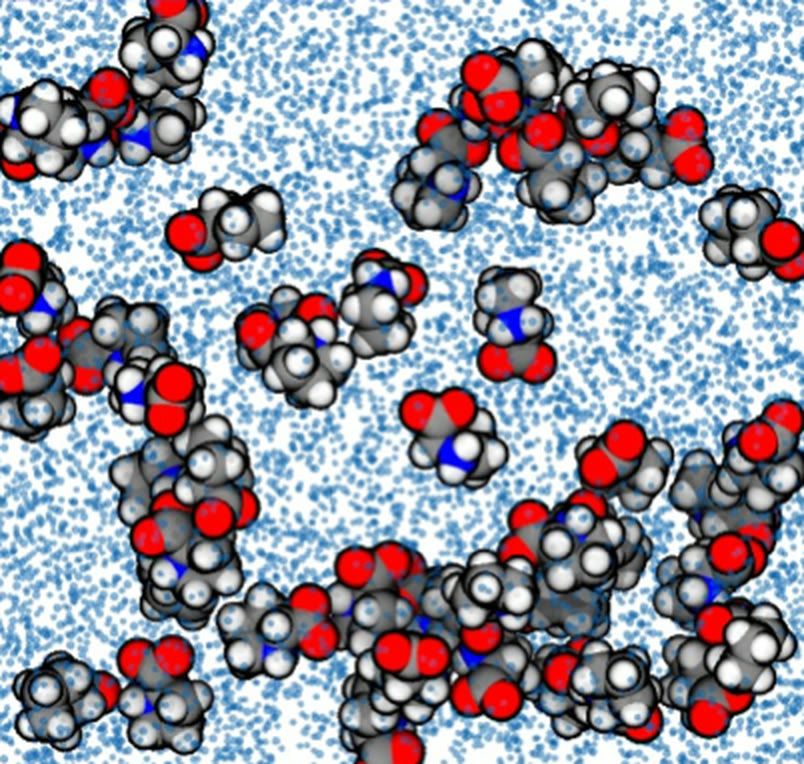
Snapshot of a concentrated amino acid solution in a simulation box~1 nm · amino acids at 2–3 M
01

Fixing the force field before trusting the crowd

Standard force fields make crowded amino acid solutions clump artificially. A targeted NBFIX correction fixes it.

Question
Can we trust standard biomolecular force fields at the packing fractions found inside a cell?
Approach
All-atom MD of five neutral amino acids (Gly, Ala, Ser, Thr, Pro) at 2–3 M with AMBER ff99SB-ILDN and TIP3P water, benchmarked against osmotic coefficients, density, viscosity and self-diffusivity.
Finding
Standard parameters overestimate zwitterion–zwitterion association and produce aggregation that experiments don't show. Increasing the amine N – carboxylate O Lennard-Jones size by Δσ = 0.08 Å (NBFIX) restores the experimental osmotic coefficients, viscosities and diffusivities without touching water–water interactions.
~4 nm · single-stranded DNA
02

Crowder chemistry, not just crowder volume

Alanine, serine and proline reshape a DNA strand in different ways, and their mixtures don't simply add up.

Question
Does a crowded environment act on DNA only through excluded volume, or does the crowder's chemistry matter?
Approach
All-atom MD of the ss-DNA 12-mer 5′-CGCGAATTCGCG-3′ in Ala, Ser, Pro and their binary mixtures, analysed with RDFs and preferential interaction coefficients.
Finding
Alanine extends the chain through excluded volume, serine stiffens it through phosphate screening, and proline induces native-like hairpins. In mixtures, crowders compete for the same backbone sites and the response becomes non-additive. Ala+Pro even gives a bimodal conformational distribution.
Paper
Manuscript in preparation
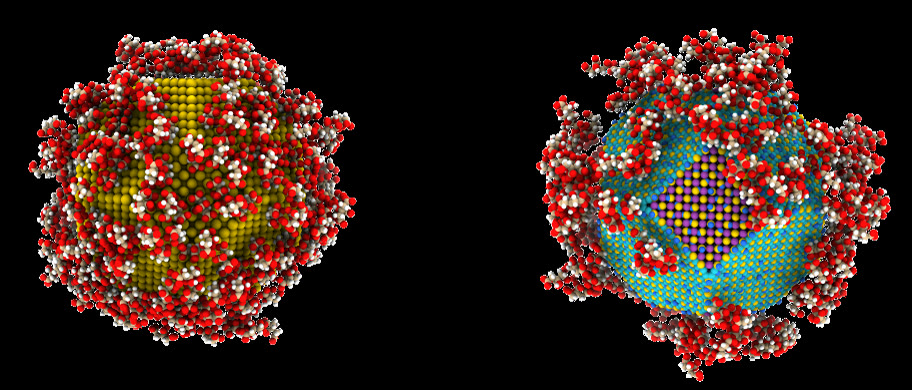
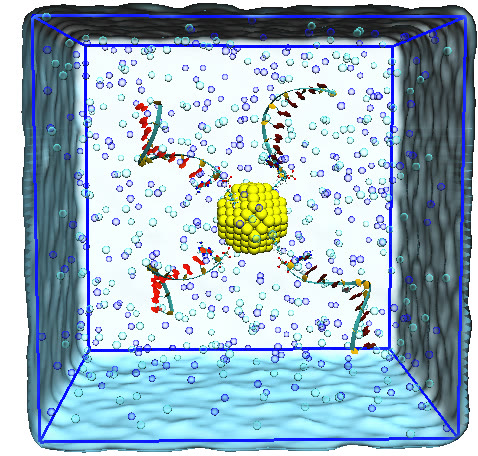
~7 nm · DNA-grafted gold nanoparticle
DNA-grafted gold nanoparticle in a simulation box crowded with amino acids
03

Glue, spacers and the effective size of a nanoparticle

Glycine sticks to gold and folds the ligands down. Glycine + serine together push them out to the largest radius.

Question
How do small crowders change the structure and solvation thermodynamics of a ligand-capped gold nanoparticle?
Approach
A T10 ss-DNA-functionalised Au201 truncated-octahedron nanoparticle in glycine, serine and their mixture. Solvation free energy was split into energetic and entropic parts with Kirkwood–Buff theory.
Finding
The gold surface adds a third interaction site. Glycine acts as a surface ‘glue’ and gives the smallest effective radius. In Gly+Ser both crowders co-adsorb, force all linkers perpendicular, and give the largest radius (35.49 Å). The mechanism is soft, direct interaction, not depletion.
1.8–11.5 nm · citrate-capped gold
Citrate-coated gold nanoparticles, non-polarizable and polarizable models side by side
04

Polarizability decides where citrate sits

With a polarizable gold model, citrate binds selectively to {111} facets. Without one, it coats everything.

Question
Is metal polarizability a technical detail, or does it change the predicted nanoparticle corona?
Approach
Six particle diameters (1.8–11.5 nm) and two surface densities, comparing the polarizable GolP-CHARMM (Drude) model with a non-polarizable gold force field.
Finding
The non-polarizable model gives non-specific, area-driven adsorption with a deep contact minimum (ΔF ≈ 58 kJ/mol). The polarizable model gives facet-selective binding on {111}, consistent with XPS, IR and STM. It also gives a shallower minimum (ΔF ≈ 36 kJ/mol), faster desorption and stronger interfacial water ordering.
Paper
Manuscript in preparation
design space · ~470k free-energy profiles
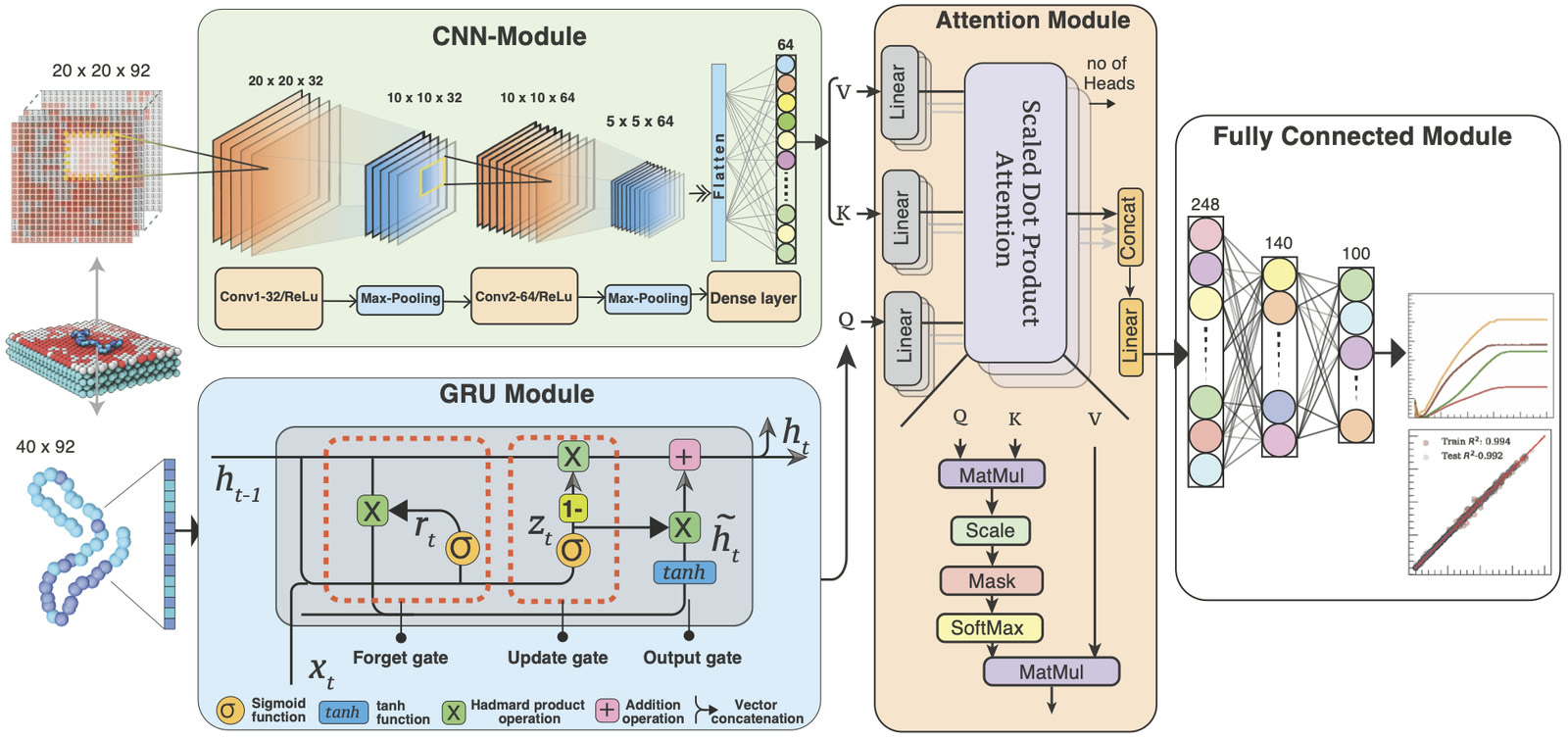
Hybrid CNN, GRU and attention network architecture
05

Learning adhesion, then running it backwards

A CNN–GRU–attention network predicts full PMF profiles from sequence and surface pattern, and a tandem model designs surfaces for a target.

Question
Can a model trained on simulation data replace umbrella sampling, and then solve the inverse problem of designing a surface?
Approach
Polymer sequences and surface patterns were generated with 1D/2D Monte Carlo Ising models at fixed composition. About 470,000 umbrella-sampling free-energy simulations were used to train a hybrid CNN (surface) + GRU (sequence) + transformer-attention model. A tandem network and Boolean particle swarm optimisation were used for inverse design.
Finding
The forward model reaches R² = 0.995 (MAE ≈ 0.45) on held-out PMF profiles, against 0.980 for a DNN baseline. The tandem inverse-design model generates surface patterns whose MD-validated PMFs match target free-energy landscapes, including outside the training distribution.
Paper
NeurIPS AI4Mat 2025 · MSDE (under review)

The thread

Chemistry beats generic pictures

At every level of complexity, chemically specific interactions decide the outcome: crowder identity, metal polarizability, and the pattern of a surface. A force field or model that blurs those details gives a qualitatively different answer, so validating it is part of the science.

What's next

Open directions

Polarizable gold for DNA-capped particles in crowded media. Protein-sized crowders via coarse-graining. Divalent-ion effects on DNA–gold assembly. Moving the adhesion models from coarse-grained beads to all-atom DNA and realistic gold and SAM surfaces.