Live simulation: DNA-coated gold nanoparticles self-assembling. Choose which strands bind, or lower the temperature to let them crystallise.
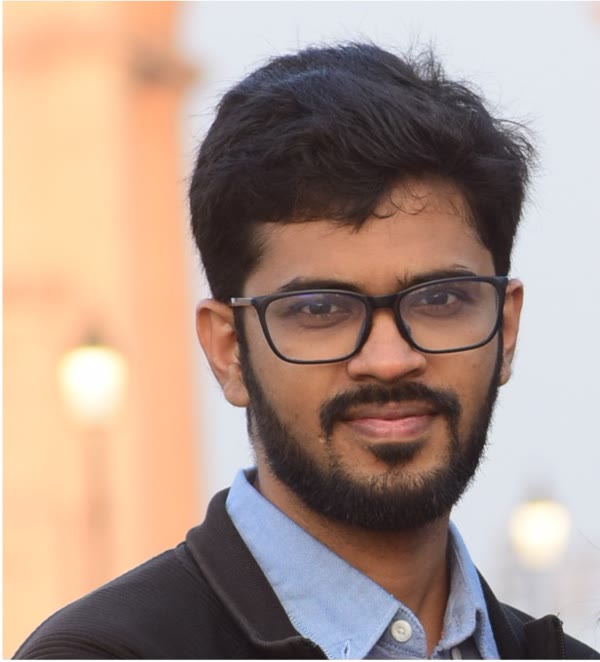
I use statistical mechanics, molecular simulation and machine learning to understand functional nanomaterials, and then to design them.
My doctoral work at IIT Delhi, with Prof. Divya Nayar, asked how gold nanoparticles coated with DNA or citrate behave in crowded, chemically complex surroundings. All-atom simulations and Kirkwood–Buff solvation theory showed that molecular chemistry, not excluded volume alone, sets their size, stability and binding. The thesis closed by turning hundreds of thousands of free-energy calculations into attention-based neural networks that design surfaces for a chosen polymer adhesion.
Today I continue this work at QpiAI, building simulation and AI methods for materials discovery.
Research themes
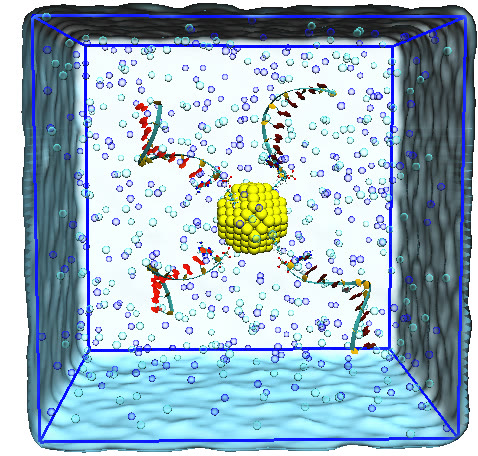
Programmable nanoparticle interfaces
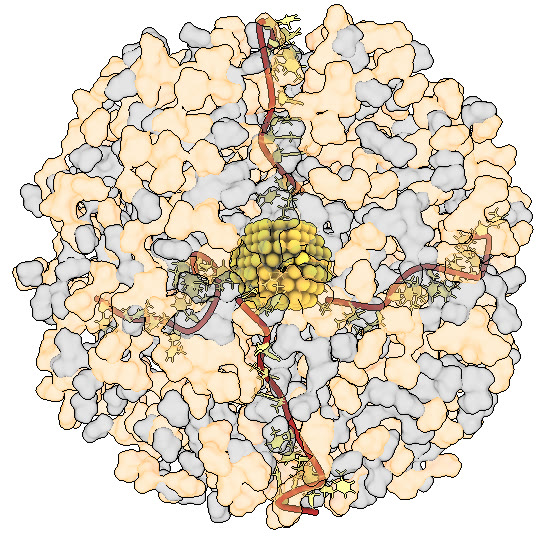
DNA- and citrate-functionalised gold nanoparticles. How ligand shells, metal polarizability and facets decide size, stability and binding.
DNA–gold and citrate studiesCrowding & solvation
Kirkwood–Buff theory and validated force fields show how chemically specific crowders reshape DNA and nanoparticles, beyond simple depletion.
Crowding studies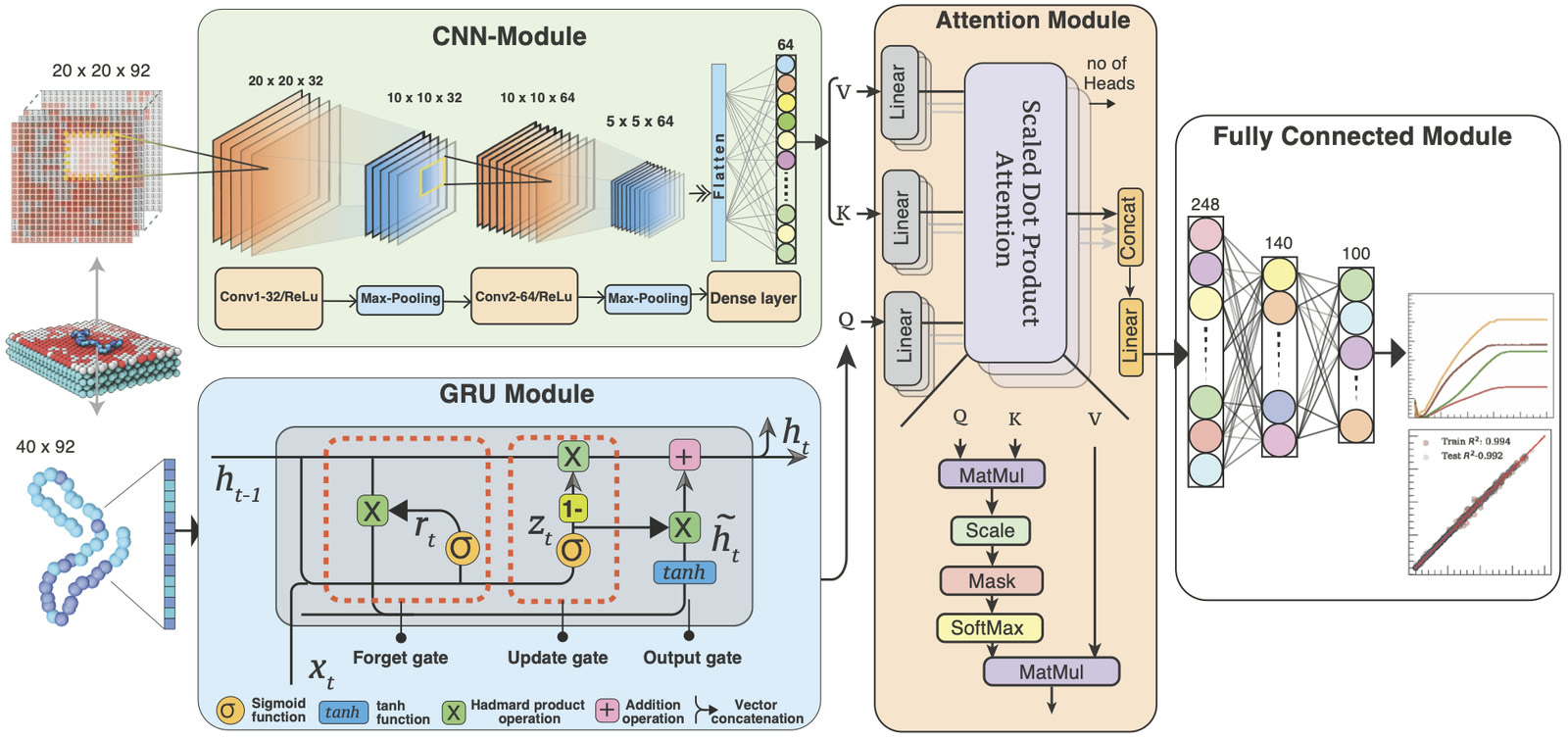
Inverse design with hybrid networks
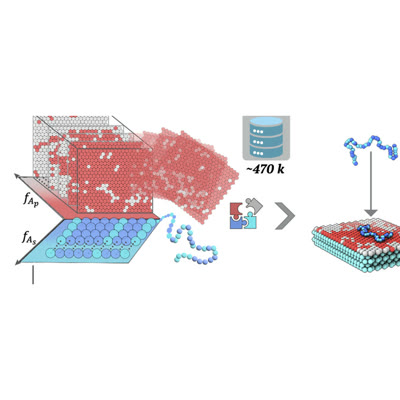
Attention-based models trained on large free-energy datasets predict polymer–surface adhesion and design surfaces for a target response.
ML for adhesionSelected publications
Prediction of Polymer Adhesion and Inverse Design of Heterogeneous Surfaces using Data-Driven Approaches
S. Panigrahy, A. James, D. Nayar
Forward prediction at R² = 0.995, and a tandem network that designs surface patterns for a target free-energy profile.
Data-driven prediction of polymer surface adhesion using high-throughput MD and hybrid network models
S. Panigrahy, A. James, D. Nayar
A CNN–GRU–attention network trained on about 470k umbrella-sampling runs predicts full adhesion free-energy profiles.
Differential local ordering of mixed crowders determines effective size and stability of ss-DNA capped gold nanoparticle
S. Panigrahy, D. Nayar
Small crowders act through soft, direct adsorption rather than depletion; a glycine + serine mixture gives the largest particle radius.
In Silico View of Crowding: Biomolecular Processes to Nanomaterial Design
S. Rajput, S. Panigrahy, D. Nayar
A review of how simulation has reshaped our picture of crowding, from protein folding to nanomaterial design.
Open research tools
Free-energy, solvation, statistics and materials tools that run in the browser and install with pip.
Learn
Eight books on the foundations of computational materials science, from first principles to current research methods, with simulations that run in the browser.
News
Opened Learn: notes with derivations and interactive models on mathematics, Python, Linux, statistical mechanics, molecular simulation and machine learning for materials.
Added three materials-science tools: FacetLab for nanoparticle structure, Bragg for powder XRD and BoxMaker for simulation-box setup.
Released an open research toolkit: WindowWise for umbrella sampling, KBkit for Kirkwood–Buff integrals and Converge for simulation error bars. Each runs in the browser and installs with pip.
Joined QpiAI as a Computational Materials Scientist.
Submitted my PhD thesis at IIT Delhi: Rational Design of Functionalized Nanomaterials for Biological Applications Using Molecular Dynamics and Machine Learning.
Presented a poster on attention-based prediction of polymer adhesion at a CECAM workshop.
From the lab notebook
All postsIntroducing WindowWise: plan, check and repair umbrella sampling
A free in-browser tool that designs umbrella windows before you simulate and tells you exactly which windows to add afterwards.
Teaching attention to read a surface
Replacing umbrella sampling with a CNN–GRU–attention network, then running it backwards to design surfaces.
Small crowders are not tiny PEG
What glycine and serine do to a DNA-coated gold nanoparticle, and why depletion isn't the right picture for them.
Collaborations & connections
The institutions, collaborators and venues my research runs through.
Worldwide
India
- IIT DelhiPhD · Computational Soft Matter Lab (Prof. Divya Nayar)
PhD · New Delhi - QpiAIComputational Materials Scientist
Current role · Bengaluru - IIT KharagpurCollaboration · Prof. Sandeep K. Reddy (force fields, PCCP 2023)
Collaboration · Kharagpur - IIT KanpurHPC resources for thesis simulations
Computing · Kanpur - DIATM.Tech, Materials Engineering
Education · Pune - NeurIPS 2025 · AI4MatWorkshop paper: data-driven prediction of polymer–surface adhesion
Venue · San Diego, USA
Let's work together
I'm open to collaborations on programmable nanoparticle assembly, force-field validation, free-energy datasets and machine learning for materials design.